
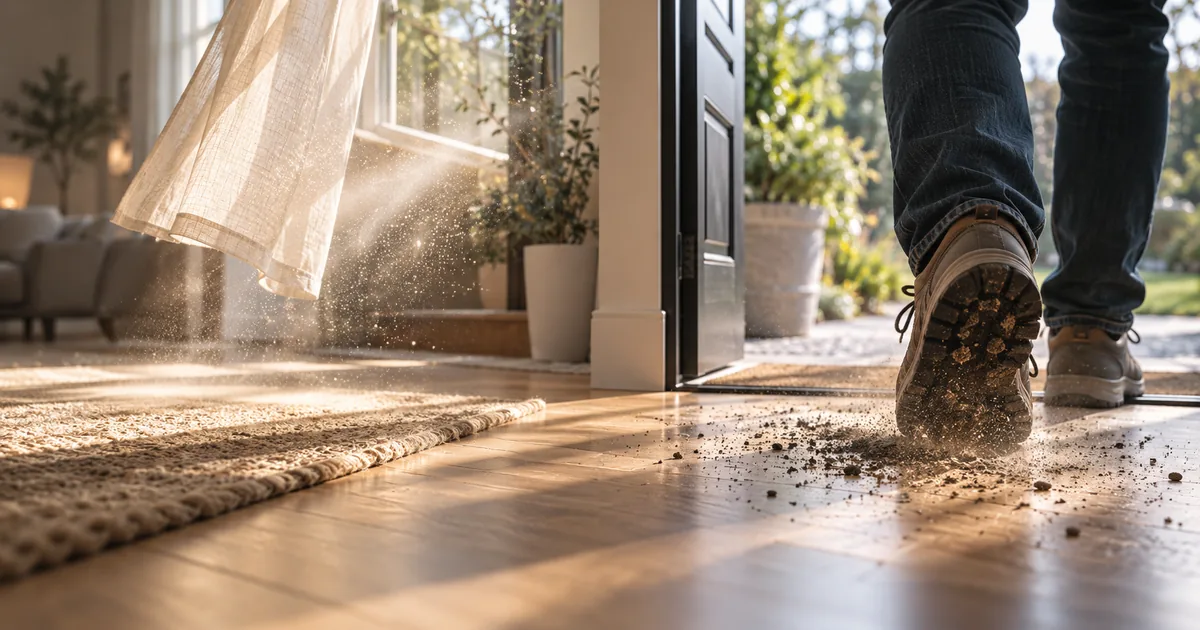
The better question is not “shoes or air?” but “how much does each pathway contribute in this building and for this contaminant?”. The answer changes with ventilation, season, building location and outdoor soil conditions.
Outdoor particles can infiltrate through ventilation and openings.
Soil and dust can be physically carried indoors on footwear.
Fibres, skin, cooking and other activities generate material indoors.
Deposition, cleaning and resuspension continuously change the mixture.
A framework that separates soil, air and organic material
A 2009 study developed a framework to distinguish soil tracked in on footwear, particulate matter derived from outdoor air and organic material generated indoors. When applied to specific contaminants, the relative contribution of each pathway varied substantially.
The same contaminant can change source over time
For lead, the authors reconstructed a historical shift: when airborne lead was high, outdoor air could dominate input to indoor dust; as emissions from leaded gasoline fell, soil resuspension and track-in became more important.
In a Rome apartment, outdoor air contributed strongly to PM2.5
A study in an occupied apartment in Rome found a significant outdoor contribution to indoor fine particulate matter, especially in summer under natural ventilation. Indoor sources still remained important for some components.
Particle size changes the pathway
Fine particles can enter more readily with outdoor air than coarse soil fractions, while physical track-in can introduce larger material that later fragments, moves or resuspends. The two pathways are not equivalent.
What an entry strategy can and cannot do
Managing the threshold can address material entering through contact with footwear and wheels, but not the fraction that penetrates with outdoor air. Entry hygiene is therefore complementary to ventilation, filtration and cleaning rather than a replacement for them.
What this distinction means for an entry solution
An entry solution should be evaluated on the mechanism it can actually influence: adherent transfer at the threshold. It would not be accurate to claim control over every source of indoor dust or particulate matter.
Sources & evidence
- Layton & Beamer, 2009 — Migration of contaminated soil and airborne particulates to indoor dust
- Perrino et al., 2015 — Chemical characterization of indoor and outdoor fine particulate matter in an occupied apartment in Rome
- Source apportionment for indoor air pollution: current challenges and future directions