01 · Contact
What we can see
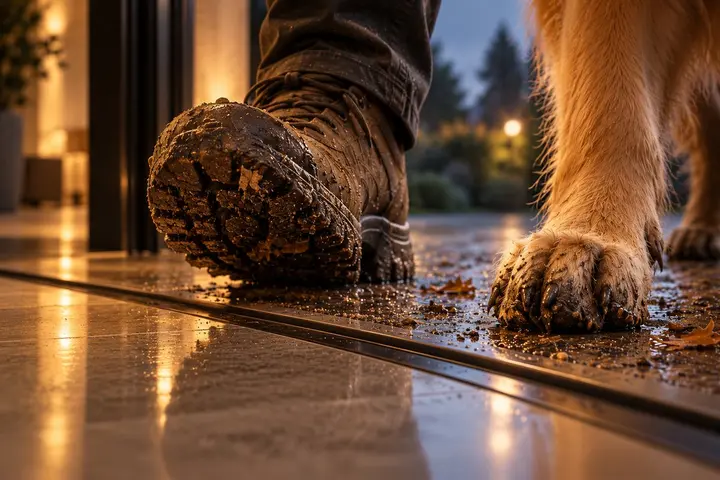
Soil, water and traces of faeces or urine can leave attached residue on paws and soles.

The challenge · From outdoors to indoors
Soles and paws contact what we find outside: soil, faeces, urine, dust and residue from treated areas. Studies also document microbiological contamination and material transfer into indoor spaces.
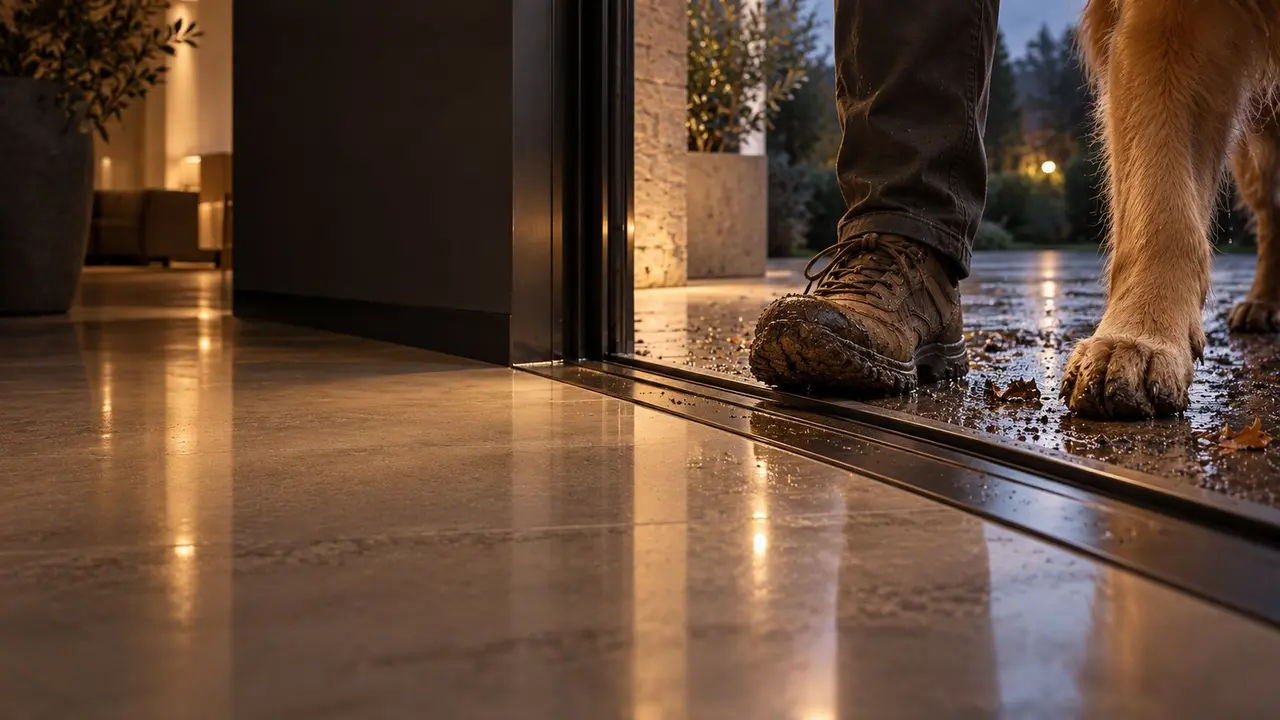
From outdoors to indoors
The process is simple: contact, transport and dispersion. Surfaces and quantities change, but the point of transition remains the moment when the two environments can still be separated.
Soil, water and traces of faeces or urine can leave attached residue on paws and soles.
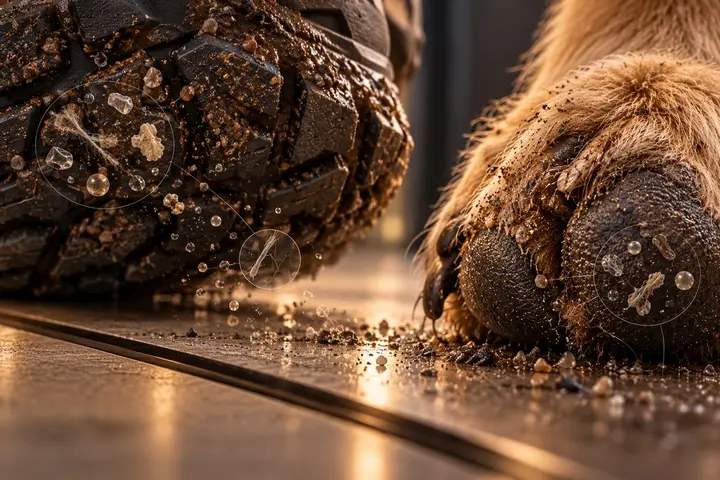
Bacteria, spores and chemical residue require specific analysis: the eye does not measure what is present.
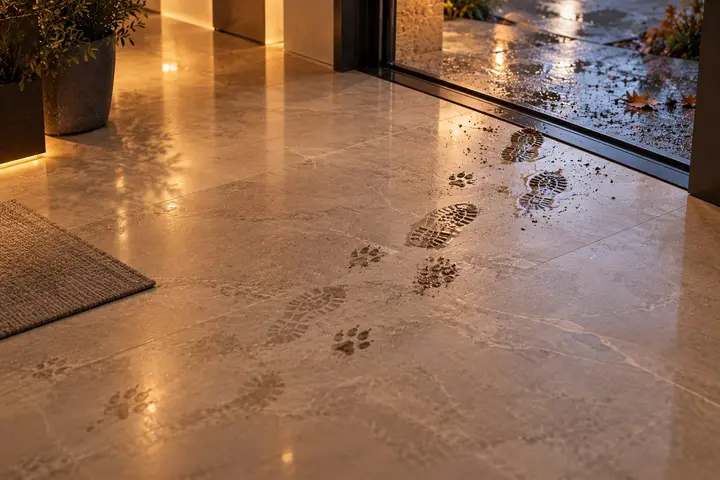
Subsequent steps can spread residue through indoor spaces.

Beyond visible dirt
The evidence covers three distinct findings: microorganisms detected on soles and paws, herbicide residue entering homes after lawn treatments, and viral material detected in hospital wards. Each finding retains its own context.
Research has documented bacteria on soles and, in targeted household studies, spores on dog paws. Detection describes contamination, not the frequency of illness in the home.
Nishioka and colleagues detected 2,4-D on surfaces and in household dust after lawn applications. Transport by an active dog and the homeowner who applied the product was significant in that study.
A 2020 study in COVID-19 wards detected SARS-CoV-2 genetic material on staff shoe soles. PCR did not measure infectious virus; the study does not establish household infection through footwear.
Studies and sources. Explore findings on soles, paws and transfer into indoor spaces. View the sources.
Change the moment of action
Regular cleaning remains essential. HYGEN KLINX explores an additional layer: reducing transfer where it occurs by integrating treatment into the act of entering.

Development and testing
PET KLINX and HOME KLINX are in development. Prototype tests will need to measure residue removal, treatment performance and safety under the intended use conditions.
The response in development