Surfaces
Faeces and urine along the route
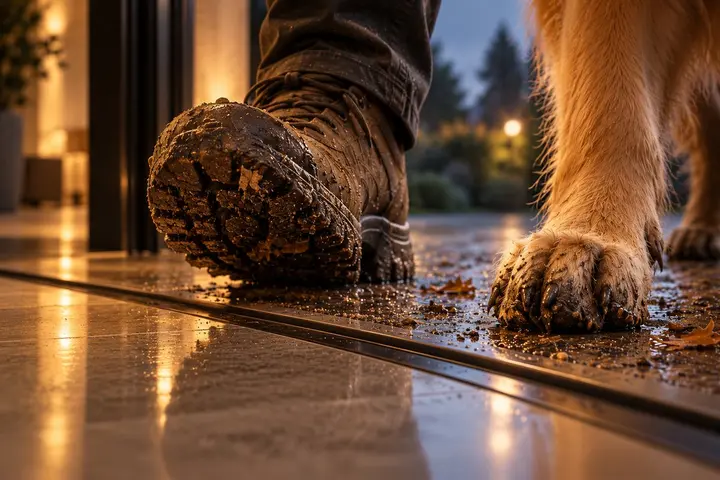
Traces of faeces and urine can mix with soil and water on the surfaces we walk across.

HOME KLINX · Footwear
Faeces, urine, dust and bacteria can reach the home on soles. HOME KLINX is the project in development for automated footwear treatment at the entrance.
The everyday problem
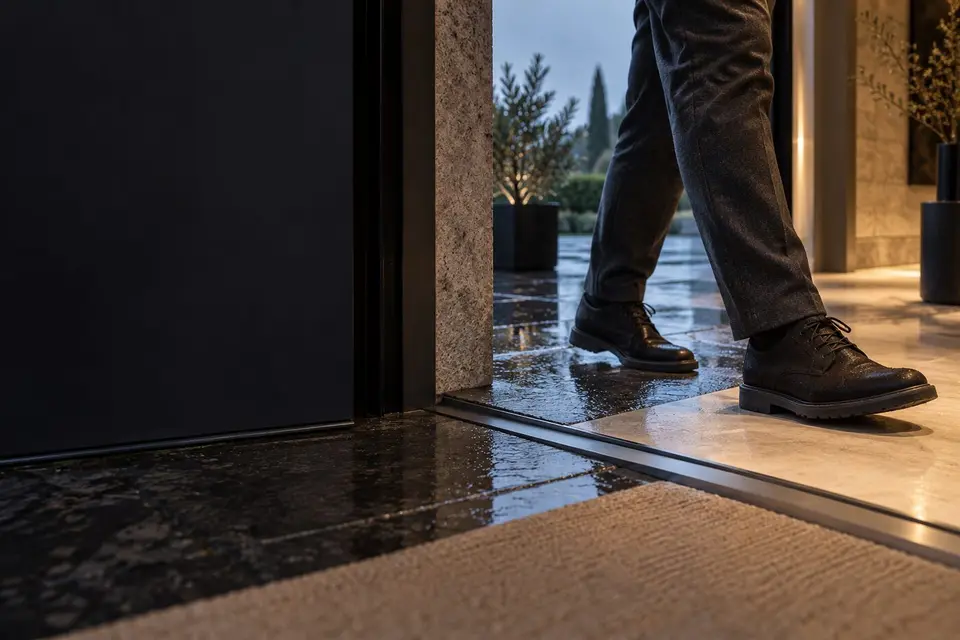
Shoes cross pavements, green spaces, transport and public areas. Contact can leave organic residue, dust, microorganisms and substances from treated surfaces.
Traces of faeces and urine can mix with soil and water on the surfaces we walk across.
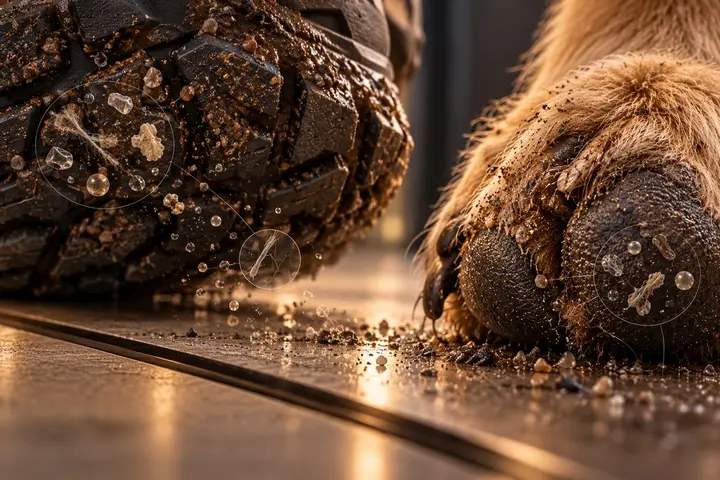
Studies have detected bacteria and spores on soles. A clean appearance alone does not measure what is present.

The herbicide 2,4-D has been documented entering homes after lawn treatments.

Environmental contamination
Tread can retain dust, organic residue and substances picked up outside after a shoe has dried. Subsequent steps can transfer some of that material to floors.
Traces of faeces and urine may be present on outdoor surfaces. Contact can leave residue on soles and paws, even when little is visible.
Bacteria and spores have been detected on soles and paws. Viral material has been detected on soles in hospital wards: the finding relates to that setting.
Studies of treated lawns documented the herbicide 2,4-D being carried into homes by footwear and animals. Transfer depends on exposure and the route travelled.
Studies and sources. Explore findings on soles, paws and transfer into indoor spaces. View the sources.
Contaminants and transfer
Faeces, urine, bacteria, spores, viral material and pesticide residue: footwear studies address different contaminants and settings. Here, the route runs from outdoor surfaces to soles and then to household floors.

A sole may contact traces of faeces and urine mixed with soil, water and material along the route. Attached residue can be picked up while walking and reach the entrance with the shoe. Looking at a sole can reveal visible dirt, but it does not measure contamination.
The origin of the material matters. The CDC documents, for example, that urine from infected animals can contaminate water and soil with the bacteria that cause leptospirosis. This describes possible environmental contamination; it does not establish that an ordinary return home in shoes causes that disease.
A 2016 systematic review brought together 13 studies on infectious agents found on shoe soles. Documented organisms included methicillin-resistant Staphylococcus aureus, C. difficile and multidrug-resistant Gram-negative bacteria. Studies covered different healthcare, community and occupational settings: they do not describe every shoe in the same way.
Detection is a concrete finding about contamination. Transfer, the amount of material and possible risk for people living in the home are further questions. A sound assessment therefore specifies the sample, setting and what was actually measured.

In 2020, Guo and colleagues sampled air and surfaces in COVID-19 wards in Wuhan. They detected SARS-CoV-2 genetic material on the shoe soles of intensive-care staff. The result shows that viral material can be present on footwear in that setting.
The study used PCR: the authors state that the test did not indicate the amount of viable virus. RNA detection documents genetic material, without establishing infectious virus or quantifying household risk through shoes.
Nishioka and colleagues studied 11 occupied and two unoccupied homes before and after the herbicide 2,4-D was applied to lawns. The compound was detected in indoor air and on indoor surfaces. Transport by an active dog and the person who applied the product was among the most significant factors.
The US EPA also identifies contaminated soil and dust tracked in from outdoors as possible sources of indoor pesticides. Findings concern defined substances, exposures and conditions: the route travelled and any treatment of the area help explain what residue may reach the threshold.
Soles and floors touch as people pass through. Acting at the threshold means addressing material carried from outside at the transition into domestic spaces. Shoe removal, entrance systems and floor cleaning remain strategies to assess around the home and the people who use it.
HOME KLINX is in development to integrate footwear treatment into the return-home routine. Tests will need to measure attached-material removal, microbiological performance and safety of use, alongside compatibility with different shoes and habits.
The concept
The user steps into the dedicated area.
The system detects correct positioning.
The sequence is designed for footwear.
The system resets for the next use.
Experience before technology
HOME KLINX is designed around the everyday act of entering. Development considers preparation, interaction and maintenance, with ergonomics and performance to be assessed through dedicated testing.
Reduce required preparation and make it clear when the system can be used.
Design an interaction that is legible, stable and consistent with a daily gesture.
Contain the sequence and prepare for the next use without shifting complexity to the user.
Project status
HOME KLINX is not yet available for purchase. Integration, ergonomics and performance will be defined and validated before launch.
Explore the platform
HOME KLINX · Early Access
Register your interest to be contacted about development and future access opportunities. The product is in development; availability and participation depend on validation.