
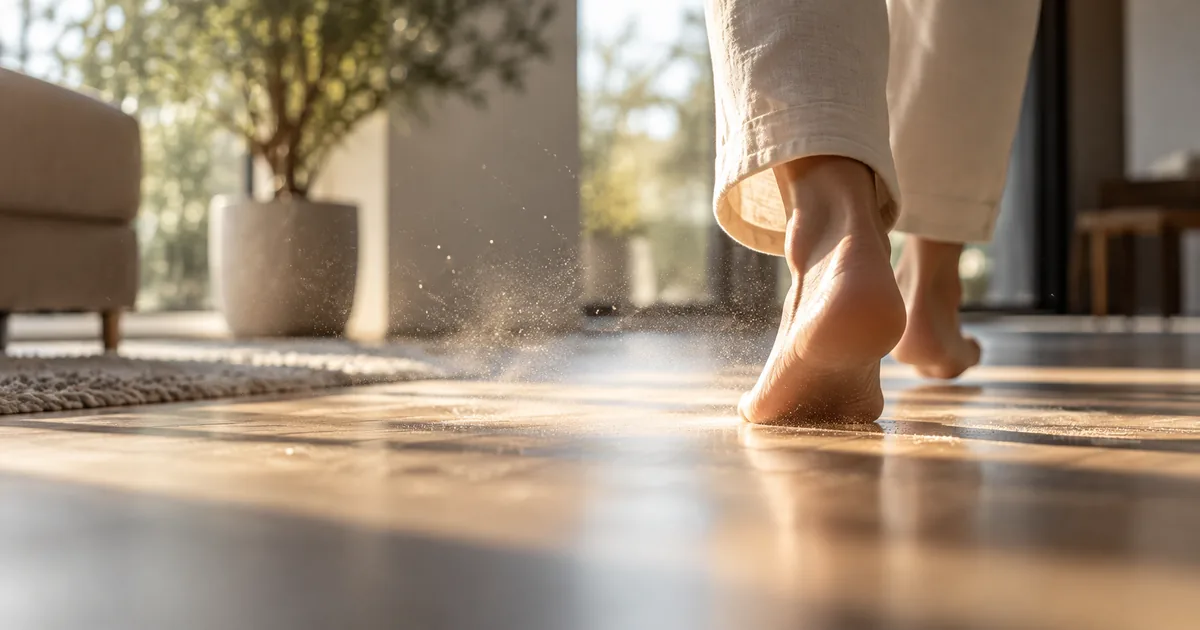
Walking-induced resuspension is a documented phenomenon. It does not mean that every step creates meaningful exposure or that all floor dust came from outdoors.
Dust and particles accumulate on surfaces.
Contact and movement disturb deposited material.
Some particles can temporarily return to the air.
Particles can later settle again on other surfaces.
Indoor dust is dynamic
House dust is a mixture of material from outdoor and indoor sources. Once deposited, it can be removed by cleaning, transferred by contact, or resuspended by everyday activity such as walking and vacuuming.
What a comparative walking study found
A 2014 study measured house-dust resuspension across five flooring types. Resuspension varied with particle size, relative humidity, surface dust loading and flooring. For the larger particle range examined, carpets showed higher resuspension fractions than hard flooring under those test conditions.
Flooring, humidity and particle size matter
There is no single value that applies to every building. Experimental studies show that flooring material, humidity, dust loading and particle size can all change how much material returns to the air during movement.
The effect has also been observed in real indoor settings
Home experiments have measured temporary increases in particulate matter during human activity. A 2008 study found higher PM10 concentrations during walking on carpet compared with background during its trials; this describes that experimental setting rather than an expected concentration for every home.
What this means at the entrance
If some outdoor material is intercepted before it spreads across floors, there is less material available to settle, transfer or later resuspend. The cited studies do not directly measure the effect of a HYGEN KLINX system on indoor air quality; any product performance requires dedicated testing.
A realistic goal: manage transfer, not sterilise
Entry hygiene can help manage soil, dust, moisture and adherent residue. It is not the same as sterilising an indoor environment or eliminating every source of indoor particulate matter.
Sources & evidence
- Tian et al., 2014 — A comparative study of walking-induced dust resuspension
- Lewis et al., 2018 — Resuspension of house dust and allergens during walking and vacuum cleaning
- Qian et al., 2008 — Estimating the resuspension rate and residence time of indoor particles
- US EPA — Sources of Indoor Particulate Matter