
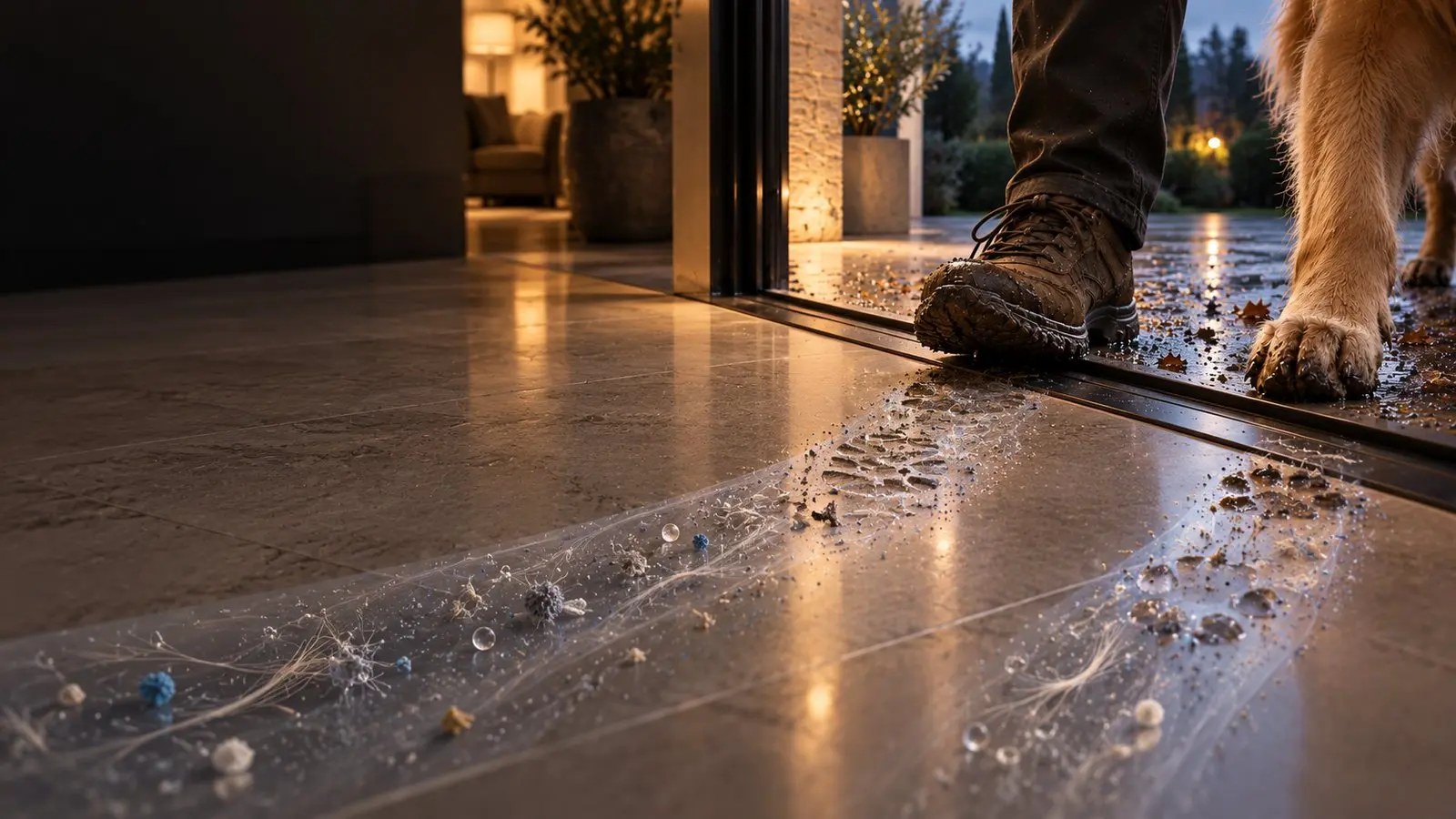
In one specific study, shoe-sole dust contributed about 4% of airborne bacteria and 14% of airborne fungi: interesting findings, not universal percentages.
Soles contact changing surfaces and conditions.
Tread, moisture and attached material change the load.
The threshold can intercept before wider spread.
Behaviour and maintenance complete the strategy.
The indoor microbiome is not the same as dangerous contamination
Indoor environments host microbial communities from people, animals, air, surfaces and outdoors. “Microbiome” describes ecosystems; it does not automatically imply a health hazard.
What the 2024 study measured
A height-resolved analysis estimated the contribution of shoe-sole dust to the airborne microbiome. In that setting, the estimated contribution was about 4% for bacteria and 14% for fungi.
What affects the percentages
The percentages depend on building, occupants, activity, climate and sampling method. They do not describe every home and they do not demonstrate harm.
Soles as an interface with the outdoor environment
Recent research also uses shoe dust to study exposure to biodiversity and vegetation. This reinforces the idea of the sole as a surface that records the environment it crosses.
What this means for entrance hygiene
Understanding the outdoor–indoor connection through mobile surfaces helps us design the threshold more deliberately. The goal is not to eliminate the microbiome, but to manage dirt, moisture and transfer consciously.
What the microbiome study tells us
The 2024 study found, in its specific experimental setting, a contribution from shoe-sole dust to part of the airborne microbiome. It is evidence of environmental transfer, not a universal percentage for homes, offices or hotels and not a direct measure of health risk.
Microbial communities and health risk
The microbiome comprises an environment’s microbial communities. The study documents the contribution of shoe-sole dust to these flows; identifying pathogens, measuring health risk or assessing a treatment requires specific analyses.
Sources & evidence
- Height-Resolved Analysis of Indoor Airborne Microbiome and the Significance of Shoe Sole Dust
- US EPA — The Indoor Microbiome