
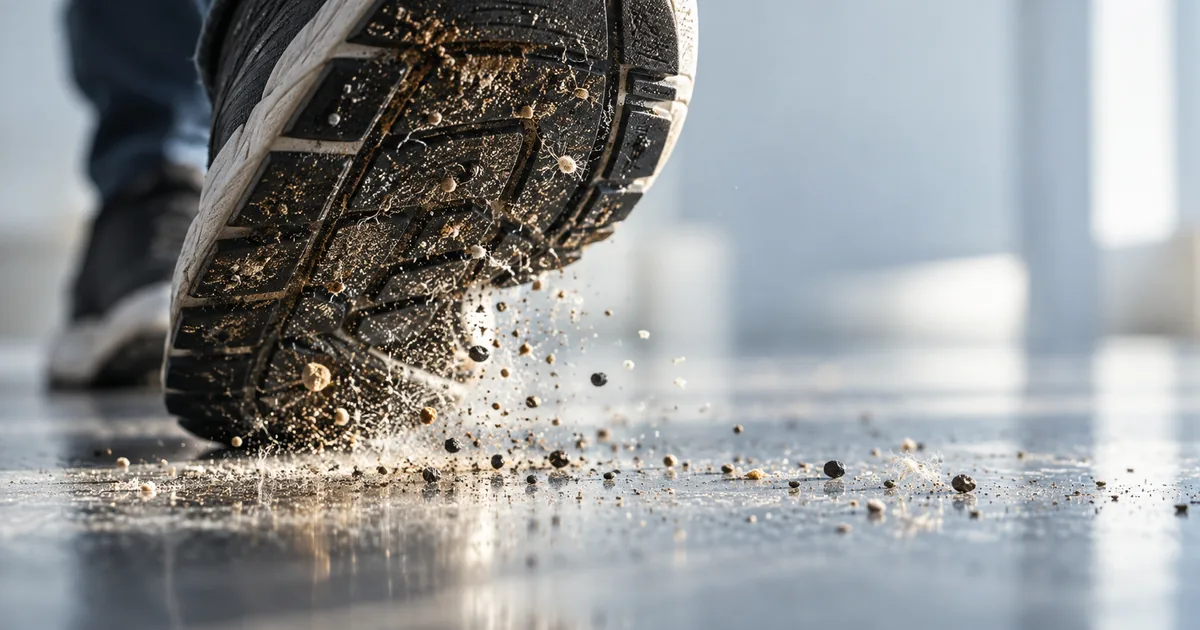
Experimental studies show that transfer depends on particle type, surface and step sequence. There is no single percentage of “dirt transferred” that applies to every shoe and floor.
The sole meets particles already present on the floor.
A fraction can adhere to the footwear surface.
Later steps can deposit part of the collected material.
Repeated transfer can move material beyond its original location.
Measuring pickup and release
A Lawrence Berkeley National Laboratory study measured particle transfer between footwear and flooring in an experimental chamber. Researchers distinguished pickup from floor to shoe from downlay, the release of particles from shoe to floor.
Transfer efficiencies vary widely
Under the study conditions, single-step transfer efficiencies covered a broad range. That variation is the important point: behaviour depends on the specific combination of particle, sole, floor surface and prior steps.
Repeated traffic can widen the affected area
Another study of soil track-in found that a single entry event tended to produce deposition over a relatively limited area, while repeated tracking could spread material across a much wider floor area.
Cleaning afterwards is not the same as preventing transfer
In the soil track-in study, brushing, vacuuming and wet wiping removed some but not all deposited material under the tested conditions. Intercepting material before spread and removing it afterwards are therefore different strategies.
Why the threshold is a useful control point
At the entrance, footwear moves from the outdoor context onto the first indoor floor. This is where some adherent material can potentially be managed before ordinary walking redistributes it further indoors.
What these studies do not show
These experiments do not measure HOME KLINX performance and do not imply that every transferred particle is hazardous. They describe a physical mechanism of pickup, deposition and redistribution that must be tested separately for any intervention system.
Sources & evidence
- Boehm et al., 2014 — Measurements and modeling of deposited particle transport by foot traffic indoors
- Hunt et al., 2006 — Mass transfer of soil indoors by track-in on footwear