
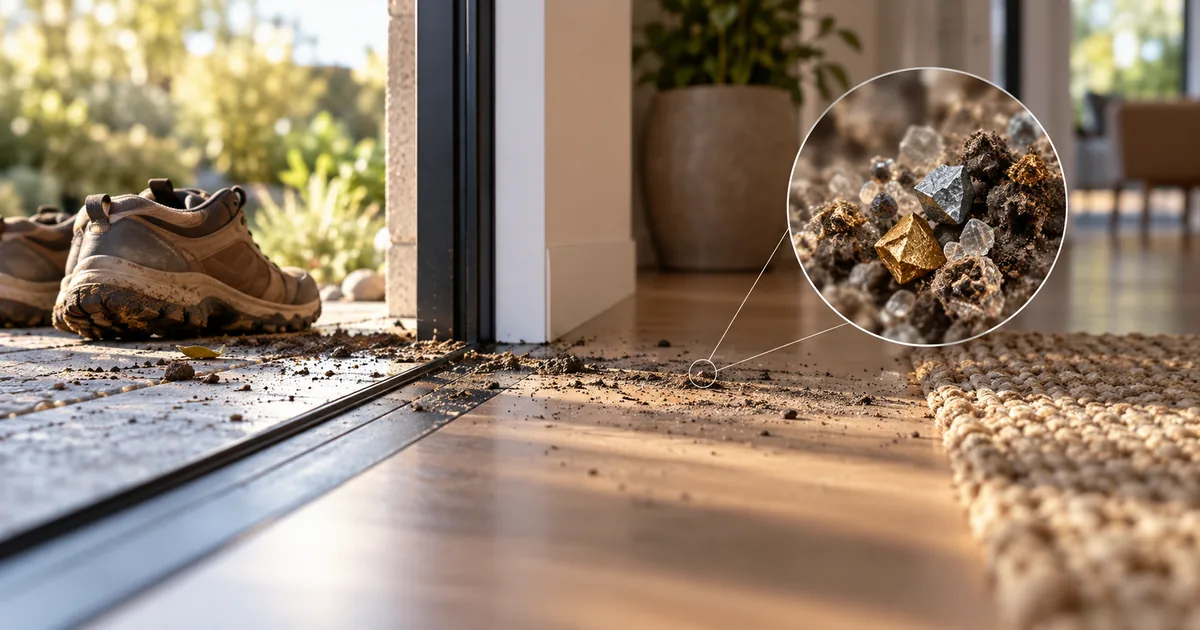
Soil transfer on footwear is measurable, but house-dust composition reflects many sources. Metals do not all follow the same pathway, and homes do not share a single exposure scenario.
Soil and road dust can contain natural elements or contaminants.
Fine particles can adhere to soles.
Repeated foot traffic can deposit and distribute soil on flooring.
Outdoor material mixes with indoor sources and other particles.
House dust has more than one source
Indoor dust is a complex mixture. Building materials, paint, household activities, outdoor traffic, garden soil and road dust can contribute in different proportions.
Footwear track-in has been measured
A 2006 experimental study measured the transfer of dry and wet soil from footwear onto hard flooring. A single track-in event produced more localised deposition, while repeated tracking could distribute material across a wider floor area.
For lead, outdoor soil can be a relevant source
Studies of homes and lead-impacted sites have documented relationships between soil lead and indoor dust. A 2022 study of Sydney homes found that garden soil remained an important source and pathway for indoor lead, whereas indoor sources appeared more relevant for copper and zinc.
Different metals can have different sources
Arsenic, cadmium, copper, lead and zinc can follow different source pathways. Detecting an element in dust does not, by itself, identify its origin or determine the exposure of residents.
Why EPA advises against tracking contaminated soil indoors
US EPA guidance on lead in soil recommends entry mats and removing shoes to reduce the tracking of contaminated soil into homes. This is source-control advice for settings where contaminated soil is known or plausible.
The role of the entrance
Intercepting soil and dust before they spread can reduce one pathway by which outdoor material enters. It does not remove indoor sources such as old paint, building materials, household activities or particles entering with outdoor air.
Sources & evidence
- Hunt et al., 2006 — Mass transfer of soil indoors by track-in on footwear
- Taylor et al., 2022 — Sources and pathways of trace metals in home environments
- Objective ranges of soil-to-dust transfer coefficients for lead-impacted sites
- US EPA — Lead in Soil
- US EPA — Reduce the Risk of Lead Exposure at Home