
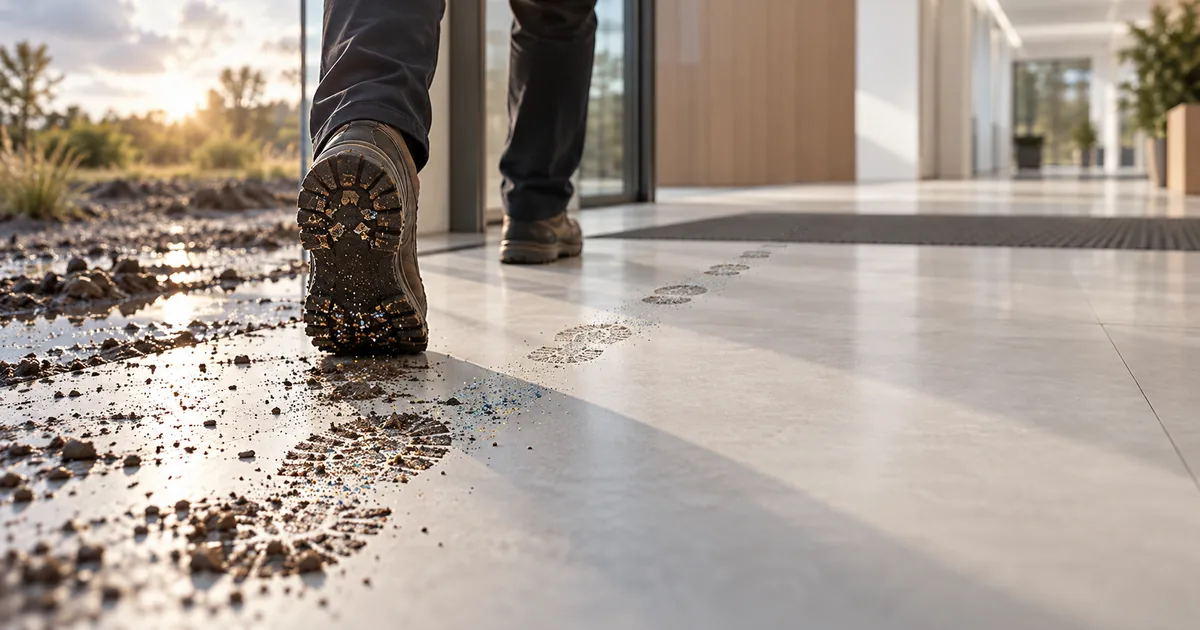
These studies come from forensic science rather than household hygiene. They are nevertheless useful for one physical principle: particle loading on a sole is dynamic and can change within a small number of steps.
The sole picks up particles from one surface.
Contact with a new environment removes some earlier material.
New particles progressively replace what was there before.
In experiments, the most recently visited site tended to dominate the profile.
The sole changes as we walk
A 2016 study exposed footwear to three environments with different mineral particle profiles. After sequential exposures, material from the third and most recent site dominated samples taken from the contact surface.
How quickly replacement can occur
A later study measured the process step by step. Under its experimental conditions, substantial replacement occurred within 5-10 steps and was nearly complete by 25 steps.
This does not mean every trace disappears at the same rate
Sole material, particle properties, moisture, pressure and surface all affect adhesion and release. The study numbers should not be converted into a universal rule for every shoe or real-world setting.
Why this matters when asking what we bring indoors
Material arriving at a home entrance may disproportionately reflect the last part of the journey: pavement, hallway, garage, garden or shared building entrance. The entire day’s history is not necessarily preserved on the sole.
The threshold intercepts a changing particle load
Managing footwear at the entrance means acting on the material present at that moment, not on everything the shoe has ever contacted. This frames entry hygiene around the material present at the threshold, without attributing to it everything that happened along the full route.
What we cannot infer
The forensic studies do not measure biological contamination, health risk or cleaning-system performance. They describe loss and replacement of mineral particles on footwear contact surfaces.
Sources & evidence
- Morgan et al., 2016 — Loss and replacement of small particles on footwear during successive exposures
- Morgan et al., 2019 — Rates of loss and replacement of very small particles on footwear