
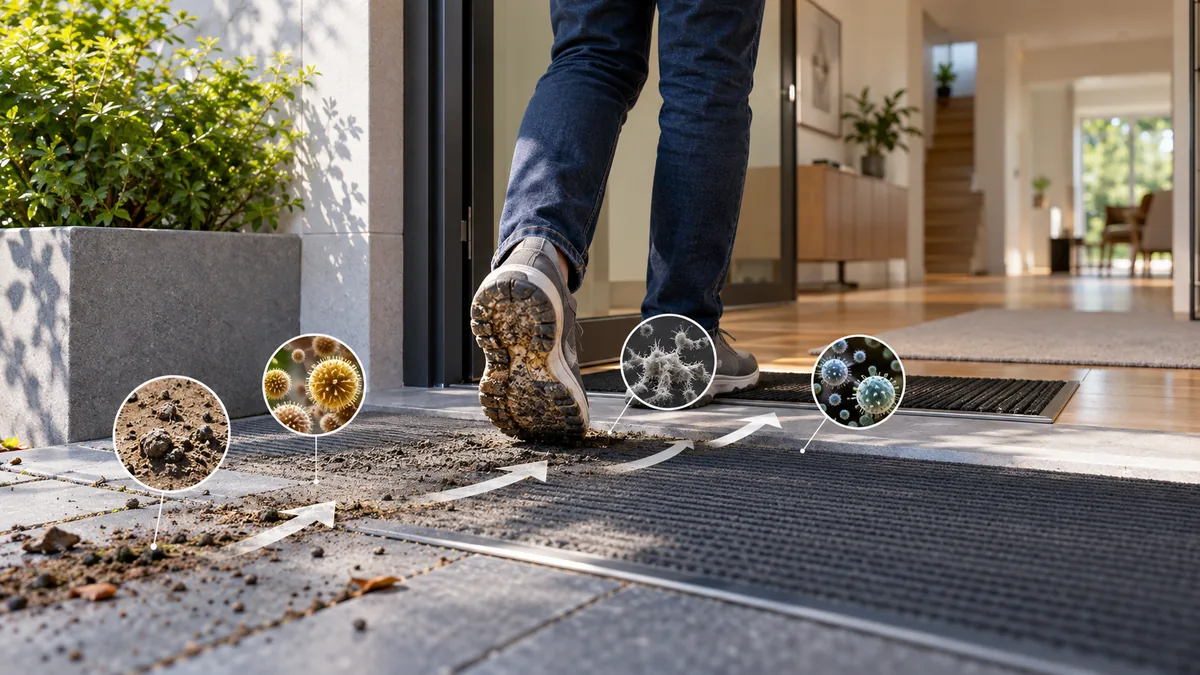
The most direct evidence comes from healthcare settings and should not be copied automatically into hotels, offices or residences. The design principle is still useful: defining where transition occurs helps organise barriers, maintenance and circulation.
People and footwear bring material from the preceding route.
A defined point separates the external and internal zones.
Transfer tends to be greater near contact and change points.
Cleaning, layout and barriers can focus on the highest-load area.
A study physically moved the footwear-change point
In a corridor leading to an operating-theatre suite, researchers measured floor bacterial contamination relative to the location where footwear was changed. The contamination peak occurred near the change zone.
Moving the transition moved the peak
When the footwear-change point was moved further from the cleaner area, the contamination peak moved with it. In that setting, contamination decreased in the protected zone. This was a specific result from a controlled healthcare environment.
Simply adding a barrier is not enough
Other healthcare studies have produced mixed results for shoe covers, dedicated footwear and street shoes. This shows that the device alone does not determine performance: route, compliance, maintenance and floor conditions also matter.
Translating the principle to ordinary buildings
For non-healthcare buildings, the lesson is not to copy hospital protocols. It is to create a readable sequence: outdoors, interception zone, optional treatment point, then interior. The more intuitive the flow, the easier it is to operate and maintain.
Maintenance should follow the real load
If dirt and moisture concentrate within the first few metres, that zone needs materials, drainage, cleaning and inspection suited to its traffic. Randomly distributed barriers can undermine operations even if each component is individually sound.
Why this matters for Building Entry Hygiene
The threshold becomes a functional micro-zone of the building. Any active or passive system needs to be integrated into circulation rather than added as an isolated object.
Sources & evidence
- Hambraeus et al., 1984 — Bacterial contamination of an operating-theatre corridor and footwear-change location
- Footwear practices and operating room contamination
- The influence of different footwear on floor contamination