
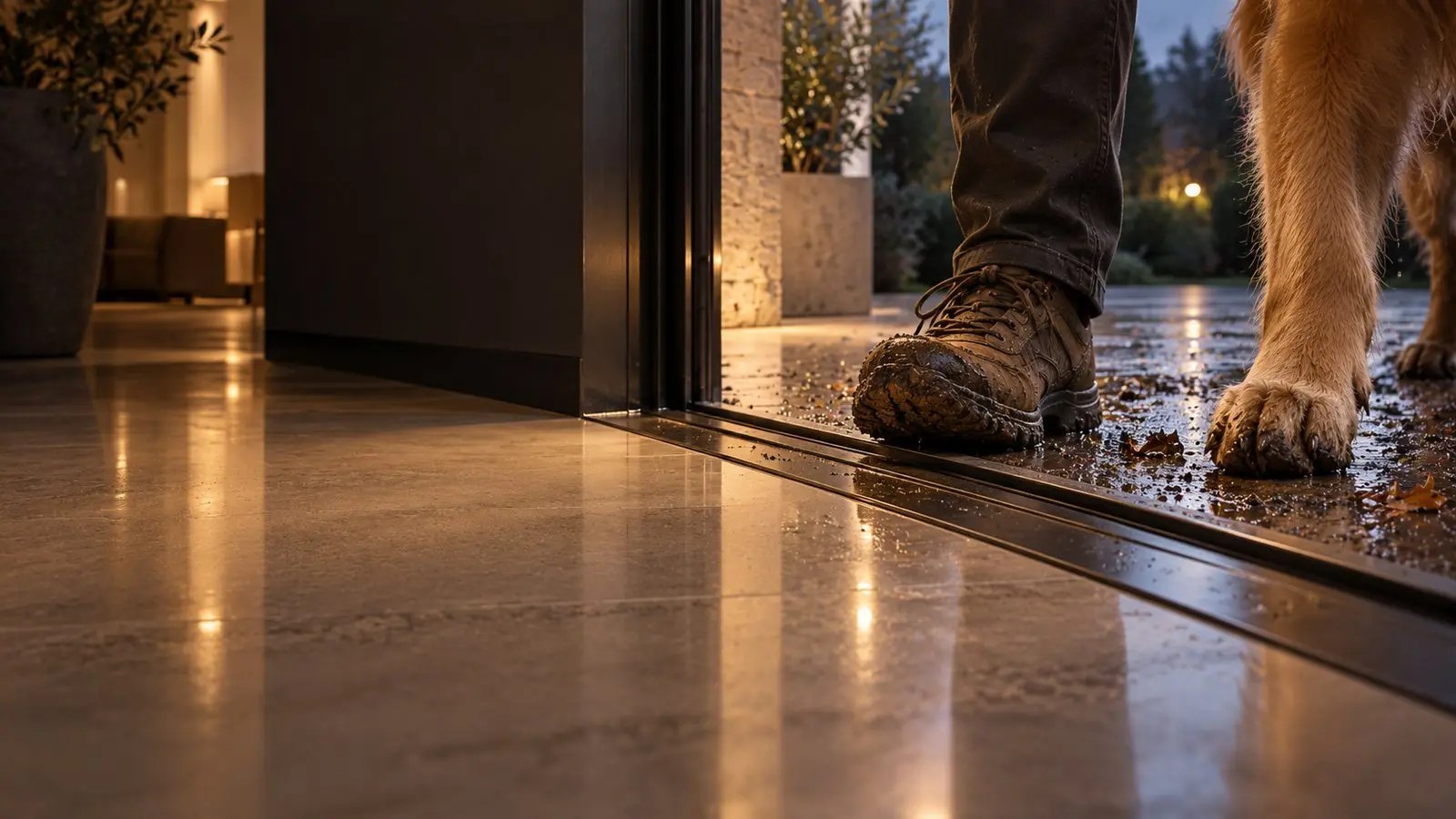
The right question is not “which system is best overall?” but which combination matches climate, traffic and available maintenance.
Traffic, climate and use define what arrives.
Space, materials and systems manage first contact.
Cleaning, safety and maintenance determine continuity.
KPIs and pilots measure real-world value.
Rollout mats: flexible but maintenance-dependent
They are easy to install and replace, but saturation, movement and cleaning affect performance. Length and coverage of the walking path matter.
Grilles and grates: capture below the surface
Recessed systems can allow material to fall into a collection zone and integrate into architecture. They require access for cleaning, drainage and early design coordination.
Slotted systems and walk-off materials
These can combine scraping and absorption in a continuous surface. Again, performance and life depend on use and maintenance.
Why standards focus on length
LEED and WELL v1 call for roughly 3 metres in the direction of travel to increase the number of shoe–surface contacts. The path itself becomes part of the function.
Beyond passive systems: dedicated technologies
An active system should be compared not only with mats but with the whole process: target effectiveness, passage time, water/energy, maintenance, safety and integration.
Compare systems by function
Grilles and scraper zones prioritise mechanical removal of coarse material; textile or absorbent surfaces manage moisture and finer particles; combined systems distribute these functions along the walking path. Meaningful comparison must include traffic, climate, maintenance and accessibility.
Where new technology begins
An active solution should not be compared with a mat as if the two were interchangeable. It must state what additional function it provides, its operating cost and the evidence behind it. Building Entry Hygiene becomes useful when passive capture, moisture control and active treatment are kept distinct.
Sources & evidence
- U.S. Green Building Council — LEED v4.1 Enhanced IAQ Strategies: Entryway Systems
- WELL v1 Standard — Healthy Entrance
- US EPA — Controlling Pollutants and Sources: Entry Mat Barriers