
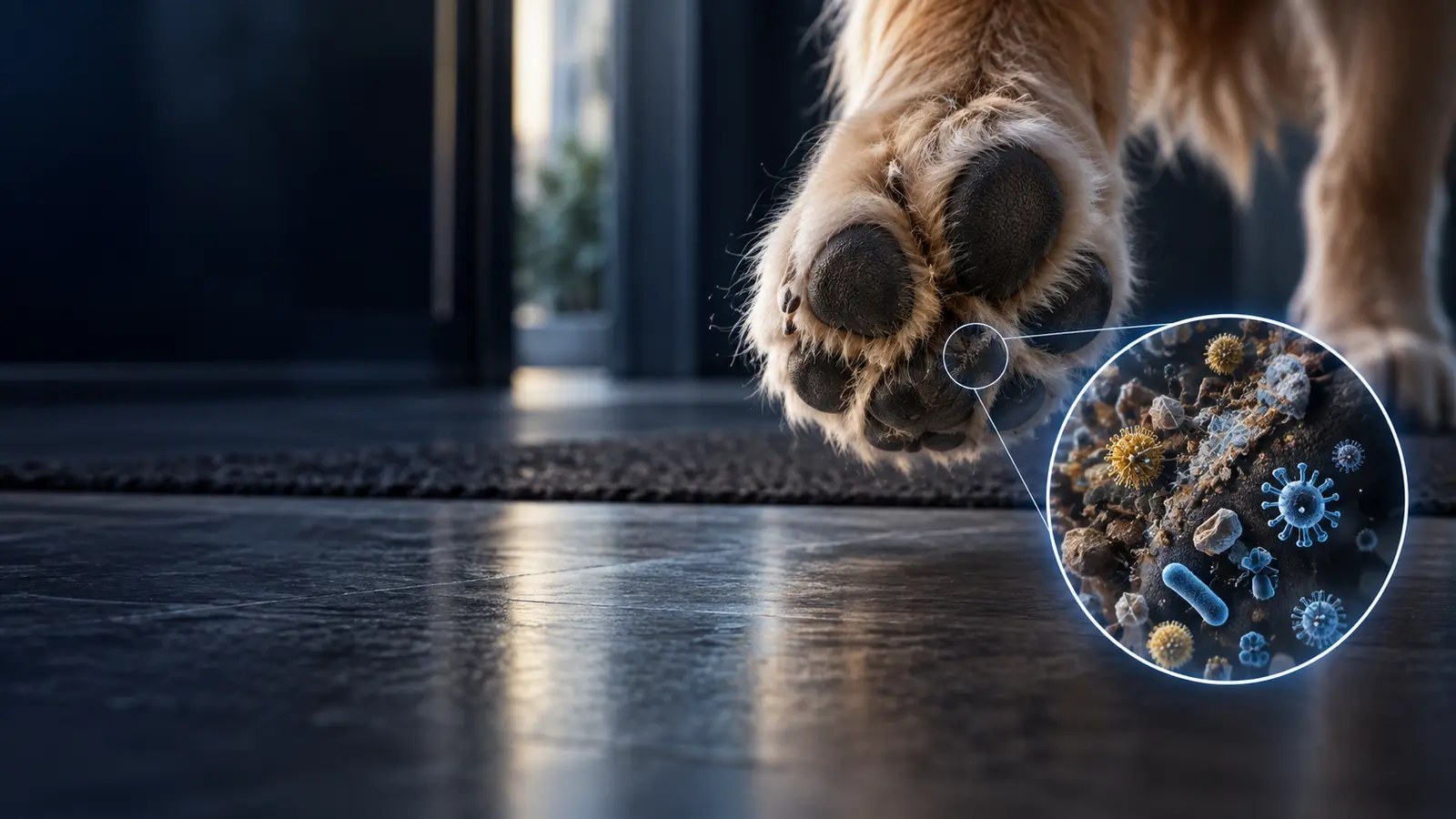
Research specifically focused on household dog paws is far smaller than the literature on footwear. Existing data show that environmental contamination can be detected, but not that every walk creates a health risk for the household.
Surfaces, terrain, rain, dust and residue.
The contact surface picks up material in variable amounts.
The threshold concentrates the moment when action may be useful.
Remaining material can be transferred to indoor surfaces.
What the available studies actually found
A 2018 study involving 20 households in Slovenia detected C. difficile in 24% of 25 dog-paw samples and 43% of 44 shoe samples. The authors suggested that paws and footwear could contribute to environmental dissemination of spores, but the study did not measure clinical risk to the households.
A second study challenges the idea that paws are “dirtier” than shoes
A 2021 pilot study involving 25 assistance dogs, 25 pet dogs and their users or owners found dog paws were more often negative for Enterobacteriaceae and, overall, carried lower bacterial counts than shoe soles. C. difficile was detected in only one sample, from a shoe sole. The result is a useful reminder that “dog” does not automatically mean “more contaminated”.
Faeces, urine, mud and residue along the route
Returning home may bring water, mud, dust, sand and material trapped between pads and fur. Contact with dirty surfaces may also leave traces of faeces and urine. Types and quantities depend on weather, ground, season and route: the routine should fit the actual situation.
What these studies do not prove
These studies do not demonstrate that dog paws cause household illness or that paws need to be “disinfected” after every walk. They show that paws are environmental contact surfaces and that visible dirt, microbiological presence and health risk should be treated as different questions.
The practical implication: inspect, clean when needed and dry
For everyday care, the cautious principle is straightforward: inspect the paws, remove residues when present and dry them thoroughly after water or cleaning. Pet Entry Hygiene organises the place, timing and tools of that ordinary care around the threshold. Wounds, persistent irritation, pain or limping belong with a veterinarian, not a routine entry process.
Treated areas and chemical residue
A household study of the herbicide 2,4-D identified transport by an active dog as a significant factor in the compound entering homes after lawn application. The finding relates to those conditions: it does not show that every walk leaves pesticides on paws. The route and any treatment of the area are decisive information.
Sources & evidence
- Dissemination of Clostridium difficile spores between environment and households: Dog paws and shoes
- A Pilot Study on the Contamination of Assistance Dogs' Paws and Their Users' Shoe Soles
- VCA Animal Hospitals — Dog Walking Safety Tips
- Nishioka et al., 2001 — Dogs, lawn herbicide and indoor transfer