
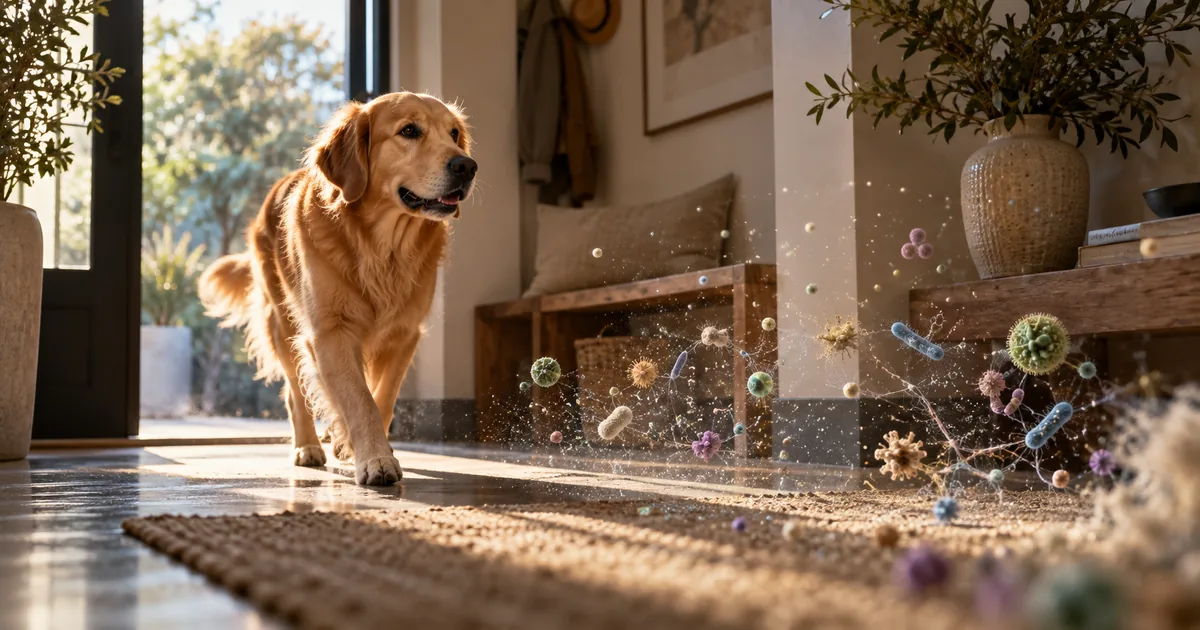
Microbiome and contamination are not synonyms. Paw care can help manage mud, moisture and adherent residue without turning the goal into sterilising the animal or the home.
Dogs contact soil, vegetation and many surfaces.
Coat, skin and paws are part of their interaction with the environment.
People, pets, air and surfaces all contribute to the indoor microbiome.
Microbial diversity and health risk are different concepts.
What is the home microbiome?
Indoor environments contain communities of bacteria, fungi and other microorganisms originating from people, pets, air, surfaces and outdoors. Describing these communities does not automatically classify the microorganisms as harmful.
Introducing a dog changes the microbiota of house dust
A 2018 longitudinal study followed families that adopted a dog and families that did not. Dog introduction was associated with measurable changes in house-dust microbiota composition, with effects observed over time.
The pattern has been observed across different cohorts
A 2021 study of Finnish and German cohorts found higher bacterial richness and differences in house-dust composition in dog homes compared with homes without dogs. The authors observed a more limited influence on fungal microbiota.
Health associations are an area of research, not a simple rule
Research has explored possible links between dog exposure, home microbiota and some childhood health outcomes. A 2026 study found that specific dog-associated microbial signals partly explained observed associations with fewer respiratory infections and less antibiotic use. These findings describe associations and potential mechanisms; they do not make dog ownership a medical intervention.
Cleaning paws is not the same as removing the microbiome
After a walk, it can make sense to remove mud, sand, road salt, plant material or irritating residues when present. That is different from trying to indiscriminately eliminate microorganisms that are part of the normal environment of the dog and the home.
Pet Entry Hygiene: residue control, not sterilisation
For HYGEN KLINX, the principle is to manage the transition between outdoors and indoors: visible soil, moisture and adherent residue. Any specific microbiological performance of PET KLINX will require dedicated testing before it can be communicated as a product claim.
Sources & evidence
- Sitarik et al., 2018 — Dog introduction alters the home dust microbiota
- Associations between dog keeping and indoor dust microbiota
- The role of dog keeping in the home microbiota and its impact on children’s health
- US EPA — The Indoor Microbiome