
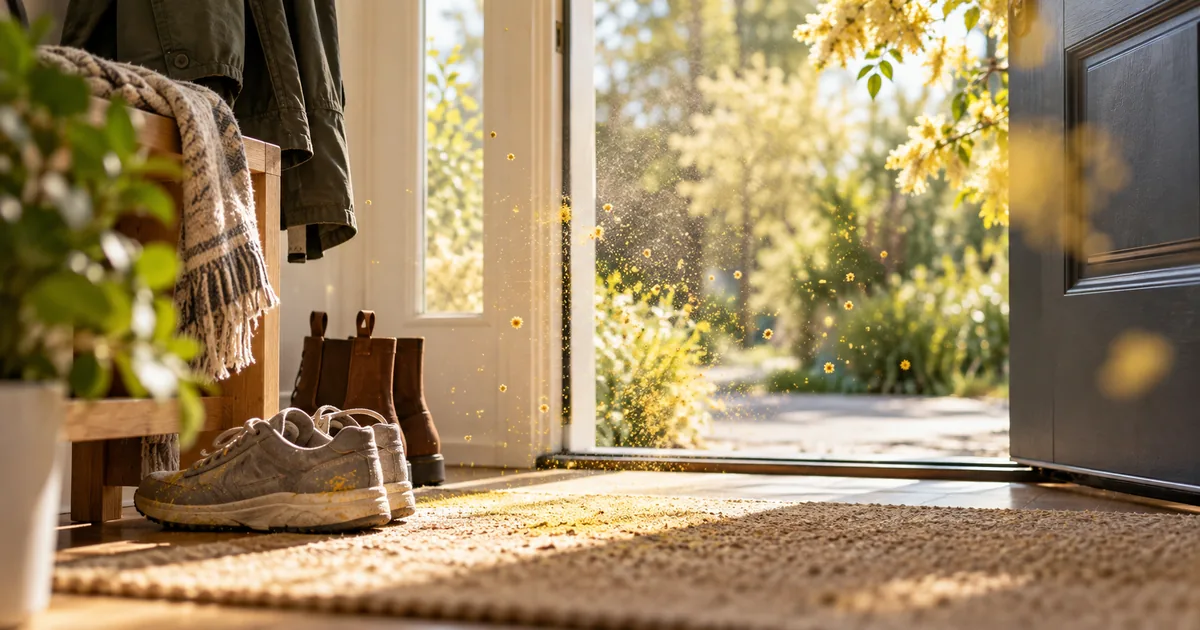
Footwear is a plausible and documented route, but it is not the only one. Windows, ventilation and clothing also contribute, so a sound interpretation should not attribute everything found indoors to shoe soles.
Pollen settles on surfaces, textiles and footwear.
People and air can carry it across the threshold.
Some becomes part of dust on floors and fabrics.
Allergens can remain detectable beyond peak season.
Grass pollen allergens in house dust
A study analysing thousands of house-dust samples in Germany detected the grass allergen Phl p 5 in a substantial proportion of samples. Levels were higher during pollen season, but the allergen was also measurable outside the peak season.
Footwear and clothing as transport routes
The grass-allergen study identified footwear and clothing as plausible routes by which outdoor pollen material can accumulate in indoor dust. An earlier birch-allergen study reported a time pattern consistent with transport predominantly on shoes and clothes.
Ventilation also matters
Other experiments show that pollen also enters through ventilation and open windows. In controlled apartments, meaningful amounts were associated with textiles and ventilation pathways, so personal transport is only one part of the picture.
Why pollen can remain after the season
Once indoors, allergenic material can settle on floors, fabrics and dust. This helps explain why pollen allergens can still be measured indoors after outdoor airborne concentrations have fallen.
What this means for entry management
During high-pollen periods, entry management can include changing or cleaning footwear, paying attention to outdoor clothing and cleaning surfaces near the door. It cannot remove pollen entering through the air, but it can address one transport pathway.
A balanced interpretation
The aim is not to frame pollen as a general hazard. For people with allergy, total exposure and individual sensitivity matter; for others, detecting pollen in house dust does not automatically imply a health problem.
Sources & evidence
- Fahlbusch et al., 2000 — Quantification of group 5 grass pollen allergens in house dust
- Birch-pollen antigenic activity of settled dust in rural and urban homes
- Two routes for pollen entering indoors: ventilation and clothes