
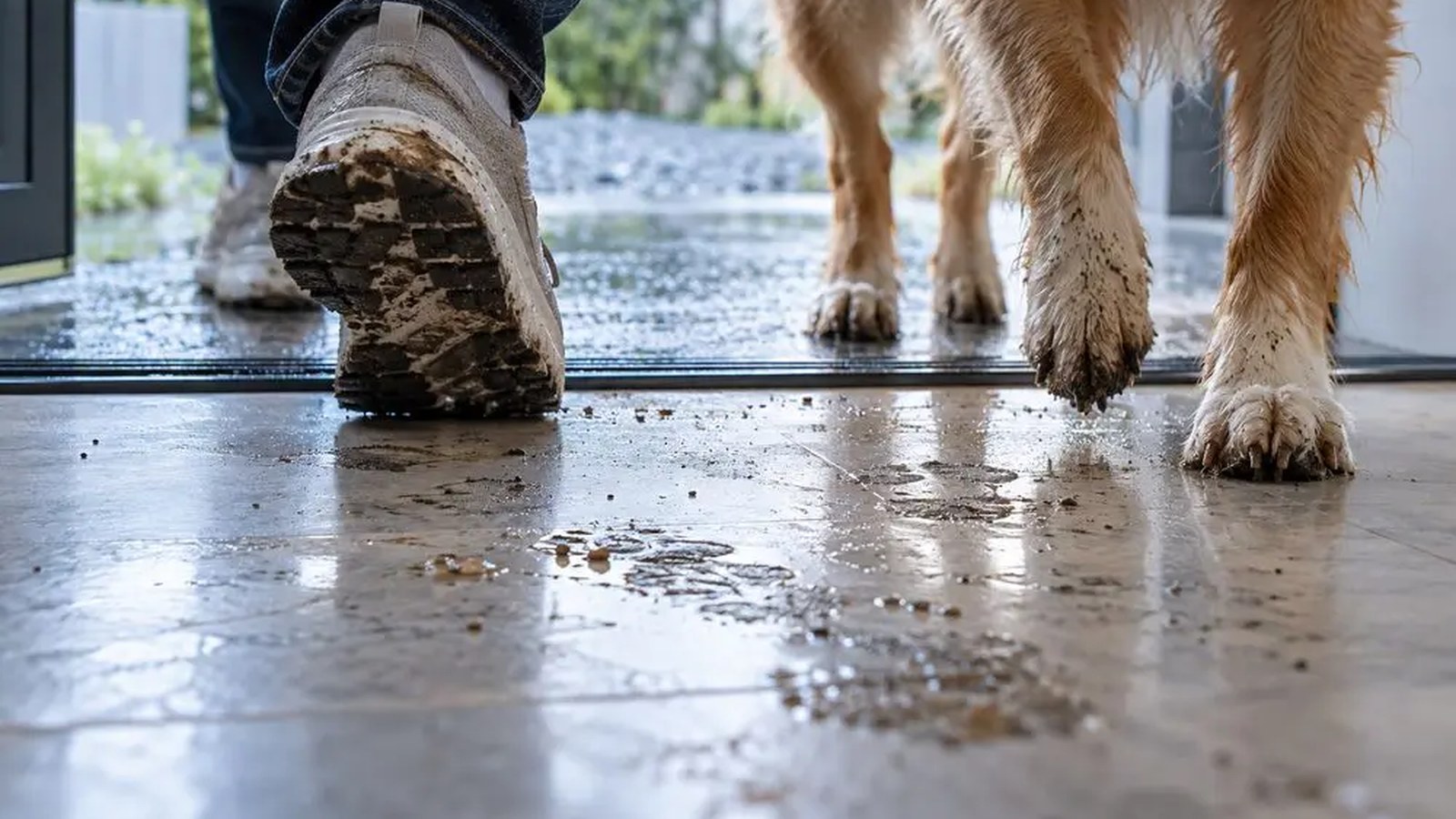
An entrance mat is neither useless nor universal; it is a passive first barrier within a broader threshold-management strategy.
Soles contact changing surfaces and conditions.
Tread, moisture and attached material change the load.
The threshold can intercept before wider spread.
Behaviour and maintenance complete the strategy.
Why walk-off systems are used in building design
Indoor-environment guidance has long treated the threshold as an interception point. EPA recommends large walk-off mats, while LEED and WELL v1 specify substantial entryway lengths to increase foot contact.
What mats do well
Suitable surfaces can remove some coarse particles and absorb moisture, reducing what is carried deeper indoors. The benefit is mainly mechanical and depends on actual sole contact.
Where limitations appear
A short, saturated or poorly maintained mat loses effectiveness. It does not control every area of the sole uniformly and is not equivalent to active treatment or microbiological validation.
Climate and traffic change the design
Rain, snow, mud and heavy traffic require different materials and maintenance. EPA even distinguishes scraping, absorption and finishing functions.
From mats to entrance hygiene
The strategic value of walk-off systems is that they show the entrance is already a recognised control point. Future technologies may extend the principle, but must demonstrate their own performance.
What determines real performance
Length, material, number of steps and maintenance all change walk-off performance. LEED and WELL v1 specify extended entry systems to increase contact, while EPA distinguishes scraping and absorbent functions. A small saturated mat should not be treated as equivalent to a correctly designed entryway system.
Dirt capture and maintenance
These systems are primarily passive tools for capturing dirt, particulates and moisture. They do not automatically demonstrate microbiological reduction and they do not replace cleaning protocols. Their strategic value is to show that the entrance is already recognised as a physical control point.
Sources & evidence
- US EPA — Controlling Pollutants and Sources: Entry Mat Barriers
- U.S. Green Building Council — LEED v4.1 Enhanced IAQ Strategies: Entryway Systems
- WELL v1 Standard — Healthy Entrance