
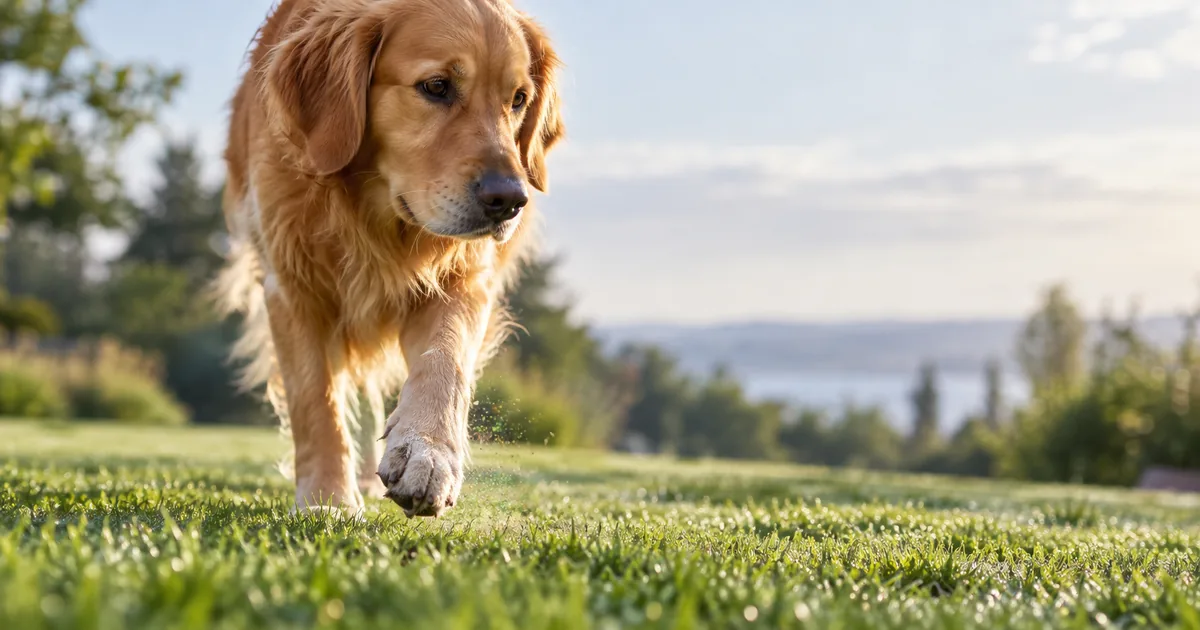
Available studies document exposure after contact with treated lawns, but they do not turn every walk on grass into a health risk. The product, time since application, surface conditions and the dog’s behaviour all matter.
The dog walks or lies on a grassy surface.
Some applied chemical may remain available on vegetation or soil.
Skin contact, licking or other routes can contribute to uptake.
Paws can be checked and cleaned in proportion to the situation.
What the 2,4-D study measured
A 1994 study measured 2,4-D in the urine of dogs with potential access to treated lawns. Higher concentrations were more likely when lawn exposure was recent. The study describes uptake and excretion under real-world conditions; it does not establish a clinical outcome.
A later study looked for several herbicides
In 2013 researchers measured 2,4-D, MCPP and dicamba in dislodgeable grass residues and in dog urine. Compounds were detected more often after household lawn treatments, but some were also found in homes without recent application, showing how drift and contact with other grassy areas can complicate exposure reconstruction.
Wet, dry and time since application change the picture
Grass condition and the time since treatment affect how long dislodgeable residues remain available for contact. There is therefore no single waiting period that applies to every product and lawn; product labels and professional instructions remain the relevant guidance.
Exposure is not automatically harm
Detecting a chemical in urine shows exposure and uptake. By itself, it does not show that a dog has been harmed or that a single exposure is clinically meaningful. Dose, duration, formulation and individual susceptibility are separate variables.
What owners can do on return home
When a lawn is known to have been treated, the first step is to respect the re-entry time specified for that product. If paws are wet, visibly soiled or have crossed a recently treated surface, pet-safe cleaning followed by thorough drying is a proportionate routine.
What this means for PET Entry Hygiene
The goal is not to sterilise paws or treat every outdoor surface as dangerous. It is to make the return home a point where paws can be checked and, when appropriate, visible or plausibly adherent residues removed before the dog moves further indoors.
Sources & evidence
- Reynolds et al., 1994 — Canine exposure to herbicide-treated lawns and urinary excretion of 2,4-D
- Knapp et al., 2013 — Detection of herbicides in the urine of pet dogs following home lawn chemical application