
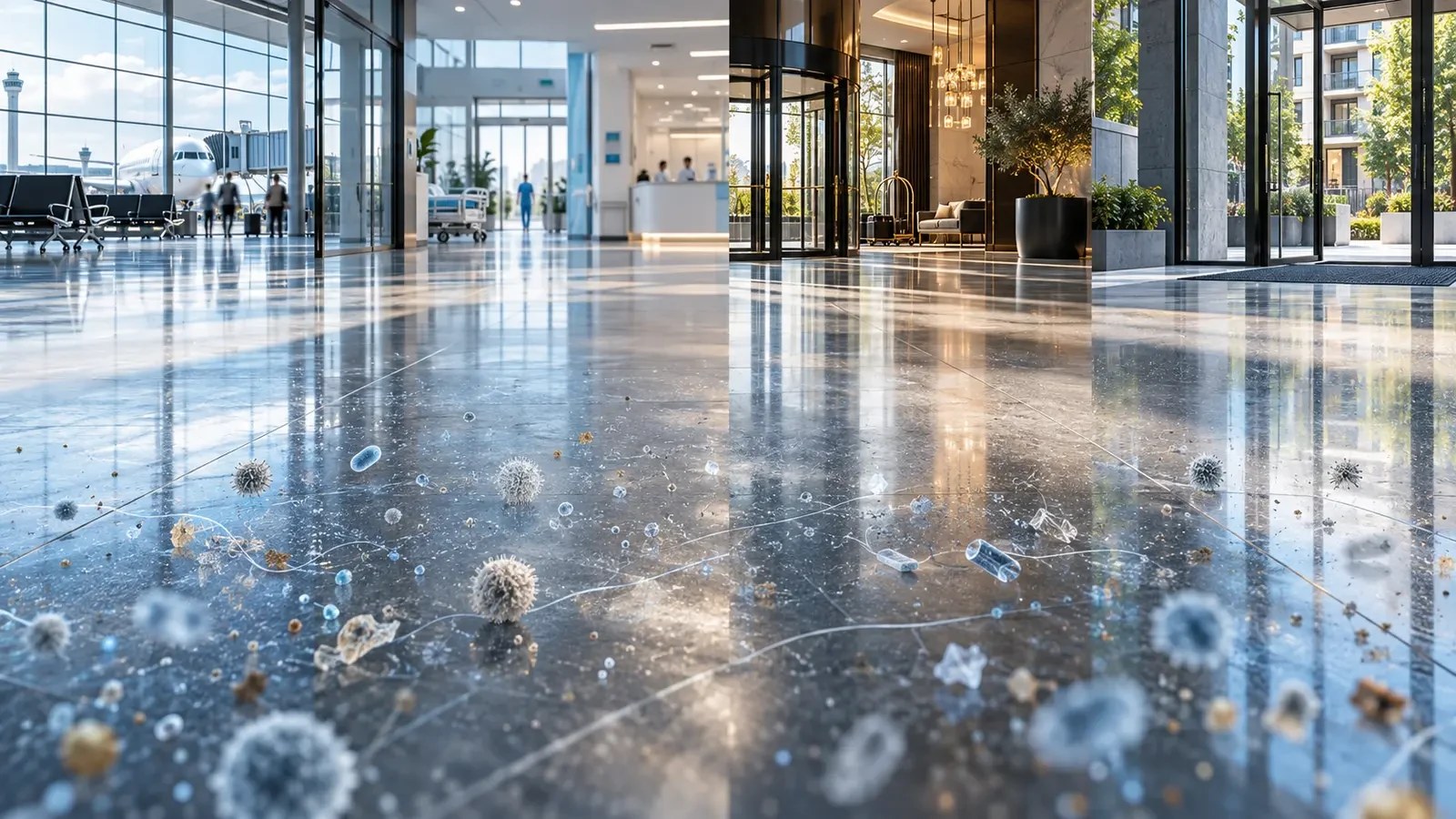
Building Entry Hygiene in the workplace means designing the threshold for traffic peaks, safety, easy cleaning and operational continuity.
Traffic, climate and use define what arrives.
Space, materials and systems manage first contact.
Cleaning, safety and maintenance determine continuity.
KPIs and pilots measure real-world value.
The morning peak is the real stress test
Many users cross the same point within minutes. Any passive or active system must retain function and safety as flow accelerates.
Moisture and slip risk
Water management matters for safety as well as cleanliness. Mats and surfaces should avoid accumulation and require consistent maintenance.
Reduce downstream load
Intercepting some dirt at the entrance can reduce what reaches corridors, lifts and work areas. Potential benefit should be assessed against the maintenance cost of the threshold itself.
Accessibility and flow are non-negotiable
An entry system must not obstruct wheels, mobility aids or evacuation routes. Design starts with the building’s requirements.
Measure before scaling
For new technologies, useful KPIs include ease of use, passage time, maintenance, user acceptance and measurable reduction of the target load. Without testing, these remain design hypotheses.
High traffic creates operational requirements
Office morning peaks compress many crossings into a short window. An entrance system therefore needs to work without queues, obstacles or water accumulation and remain accessible to wheels and mobility aids. Operational capacity matters as much as capture performance.
What a workplace pilot should measure
Beyond the technical endpoint, a test should record throughput, average transit time, maintenance interventions, system availability and user acceptance. Only then can the team assess whether source control reduces downstream work or transfer. These KPIs are a proposed evaluation framework, not a LEED requirement.
Sources & evidence
- US EPA — Controlling Pollutants and Sources: Entry Mat Barriers
- U.S. Green Building Council — LEED v4.1 Enhanced IAQ Strategies: Entryway Systems